
For EnigMarch 2026, we asked puzzle designers to walk us through the creation of a puzzle of their choice. Read on for a tutorial by EnigMarch organizer Ossandra White on how to create a rebus puzzle.
Rebus puzzles can be fun. They can be silly or serious. They can be simple or super challenging. They can be lovely if you are an illustrator or designer trying to put your skills and expertise to use in a puzzly way. They can be a lifesaver if you’re short on time. They can be a neat change of pace if you want to switch things up. They can stand all alone and hold their own. They can band together as part of a larger puzzle.
Before we get into specifics, I’d like to explain what exactly we’re talking about for those who may not know. A rebus is a puzzle that uses imagery, letters, and symbols to convey a message. Sometimes, they paint a funny and clever picture. Sometimes, they use spelled-out words in creative ways. Sometimes, they are solved through phonetics. Here’s an example. See if you can figure out what it means:
🍞 – 🅱️ + 💇 + 💍
Did you get it? Let’s break it down.
First, we have a picture of a loaf of BREAD. We then have a minus sign followed by the letter B. This indicates we should remove the B from BREAD, which would give us READ. Next, there is a plus sign and a picture of a person getting their HAIR cut, along with another plus sign and a RING. So, trying to sound out the words, READ HAIR RING gets us the phrase RED HERRING.
That was pretty fun. It was a bit easy, but it was also quite silly. Rebuses are popularly used for quick quips and fun sayings, but they can also be much more complicated. Here are a few sites that you can visit to find more clever rebus examples!
- Rebus-Puzzles.com: A virtual stack of colorful rebuses to browse through. There’s also a daily puzzle.
- Rebus Game: A new rebus appears whenever you reload the page. Try to solve it as fast as you can! There is also a letter count to help you gauge what saying you are looking for.
- Justfamilyfun.com: Five hundred rebus puzzles and answers in printable PDFs for download.
Creating a Rebus
When creating a rebus, it’s good to first have a think about what kind of message you want to convey and backform it. Are you trying to allude to a popular saying? Are you giving directions to follow? Are you referencing a song?
If you don’t yet know what to backform from, perhaps scroll through images, emojis, or other rebuses so that you can find inspiration. What homophones jump out to you that you could use to make an interesting puzzle? Take those and then try to come up with an ending answer.
Once you have settled on the solution, work out how you want to construct the rebus.
Rebus Features and Functions
There are several features used in rebus puzzles that serve different functions. Each instructs the solver to do something or provides a clue that may help the solver shift into the mindset needed to find the answer.
Equation Directives
The first example I gave at the beginning of this post contained equation directives. There were pictures with instructions to add and subtract. This often works in rebuses to denote sounds or letters to be added or subtracted from whole words.
Phonetic Sounds
Sometimes, letters or pictures featured in a rebus indicate phonetic sounds that, when put together, create a word or phrase that makes sense. For these functions, part of the puzzle is figuring out what the pictures are meant to be called. Here’s an example.
🛏️ 🕙 🏪 E
In this one, there is a bed, a clock, a building, and the letter E. If you say BED CLOCK BUILDING E, nothing happens. So, what are other words for these symbols? Perhaps instead of CLOCK, we want what numbers the hands are pointing to? No. That doesn’t make sense either. Perhaps TIME is what is needed. And what is this building? Could it be a gas station? A shop? A STORE? BED TIME STORE E. Ah. BEDTIME STORY.
Positioning
The fun of rebus puzzles is playing around and getting clever. Not everything is straightforward. Not everything is laid out in a left-to-right line. You can get as creative as you’d like with these kinds of puzzles. The size, distance, and proximity of the pictures or words to each other can work nicely in creating an interesting clue. Here is an example:
SOMEWHERE
rainbow
This one may be simple, but it is still a rebus! The word SOMEWHERE is positioned OVER the word RAINBOW. The answer is the classic song lyric “SOMEWHERE OVER THE RAINBOW.”
Literal Meanings
Sometimes, figures of speech can be displayed in a literal way with rebuses. Illustrating something being done to words or pictures can help to form an idea in the solver’s mind. Making something big or small, splitting or cutting something, even manipulating pictures with effect, like in this example:
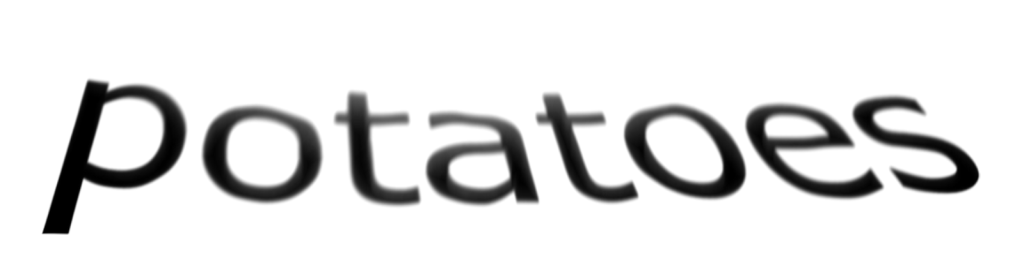
For this one, the words appear to be smashed. Smashed potatoes? MASHED POTATOES.
Designing Your Rebuses
When making rebus puzzles, you don’t have to use pictures. It is possible to create a rebus using letters or words alone. But you still may want to use pictures, or make the words look more fun. You can do this by creating your own art! Write the words yourself, draw pictures, or make cool designs that are special and uniquely your own. If you aren’t sure where to start, here are a few online tools that may help:
- Sketchpad: Create art of your own and export it in several formats.
- Piskel: Make fun pixel sprites and animations.
- Make Wordart: This site emulates classic Word’s different WordArt styles, complete with Clippy to boot.
However, if you are artistically uninspired, are running short on time, or otherwise would rather use existing art, you can always use ready-made pieces. As creatives, it’s important to give credit and respect permissions when using other art in our endeavors. Below are some nice sites that have tons of free-to-use art for creative projects!
- Canva: Many people use Canva for creating. Their software has a built-in image library. They also have several options for formatting and positioning text.
- Pixabay: This site has good search features. You can find photos, videos, illustrations, 3D models, and more.
- National Gallery of Art Free Images and Open Access: This site offers a wide selection of free artworks available for download.
- Openclipart: This site has thousands of images. It is powered by ads, however.
Things to Consider
Rebus puzzles are fun, but they can sometimes cause discrepancies. Just because discrepancies can happen doesn’t mean you should avoid creating rebuses altogether. Still, it is always a good practice to keep your audience in mind when creating.
Sometimes, a rebus may be lost in translation due to accents, dialects, or differing names for pictured objects. Recently, I came across a puzzle from an Australian who used a picture of a woodcutting SAW to indicate the word SORE. Personally, those are not interchangeable homophones in my accent, but that didn’t stop the puzzle from being fun! It just took a bit of extra thinking (and maybe some other solvers) to point out the answer.
Another thing to think about is accessibility. As with most puzzles that feature images, rebuses may be difficult to enjoy without seeing. Some screen readers can read emojis, so if you use emotes (like I did at the beginning of this article) or typed words (like I did in the middle), those who have impaired vision may still be able to understand. If you use illustrations or other images (like I did with the potatoes), it could be helpful to use alt text to describe what is being shown.
Remember that there’s no such thing as a puzzle that everyone in the world adores. All of our brains are different! It’s okay that some puzzles click while others may not be our cup of tea. At the very least, some puzzles may take getting used to. For me, it’s fun to try new things when creating and solving. If you haven’t worked with rebuses before, I suggest you give it a go!
 EnigMarch